-

·
Beaver Notecard
Beaver (Castor canadensis) Beavers are found throughout North America except the Southwest and Mexico. To beavers a pond is security… they are primarily aquatic. While swimming underwater, they have the ability to close their noses and ears as well as close a clear eyelid to protect their eyes from water and debris. The tail is…
-
·
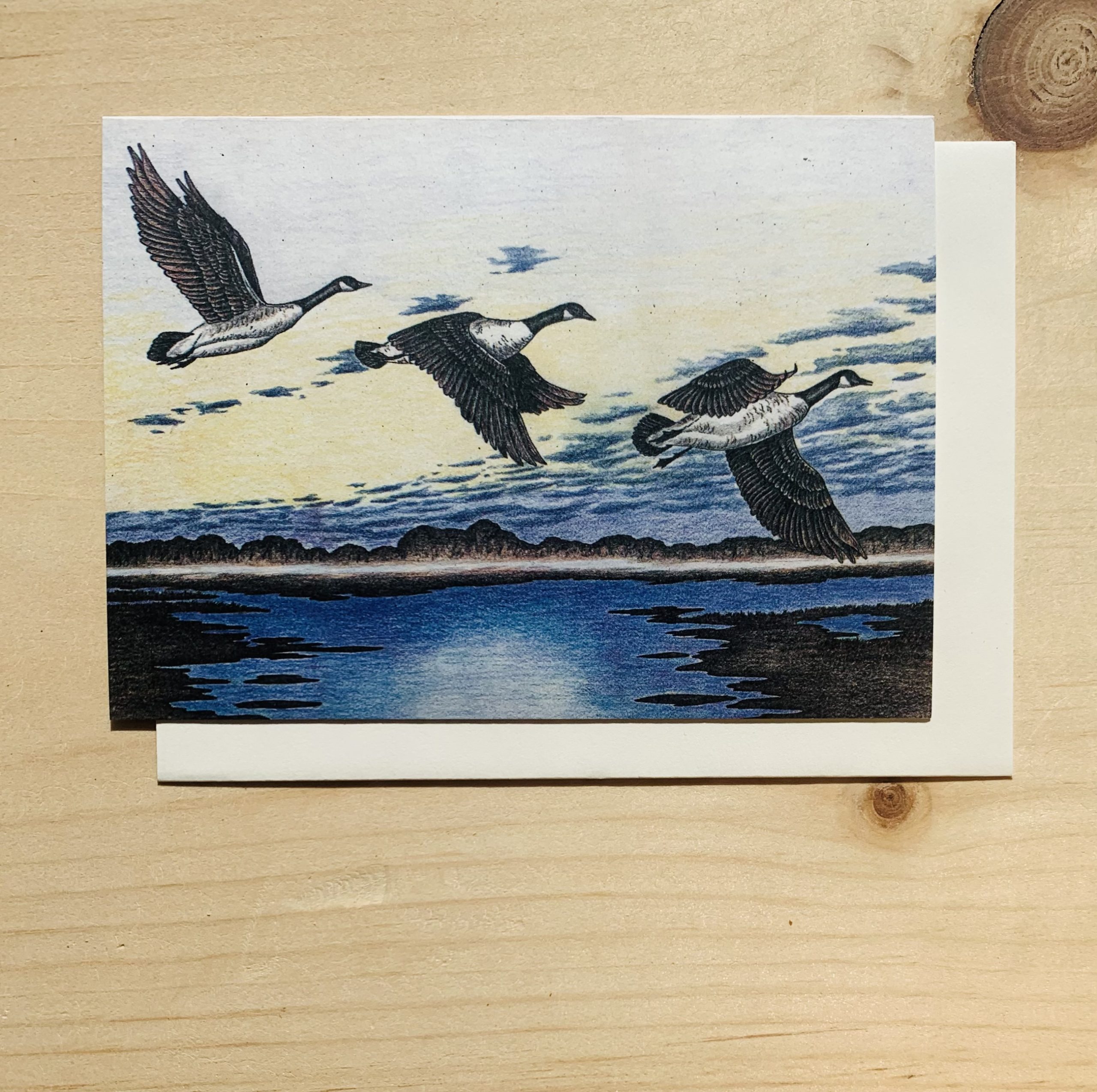
Canada Geese Notecard
Canada Geese (Branta canadensis) The insistent, musical honking of Canada geese in V-shaped migratory flocks foretells the coming of fall and the return of spring. The wedge-shaped formation, typical of many waterfowl, has aerodynamic and energy-saving advantages. The lead position requires the greatest energy expenditure and the leader changes periodically. Canada geese migrate by day…
-

·
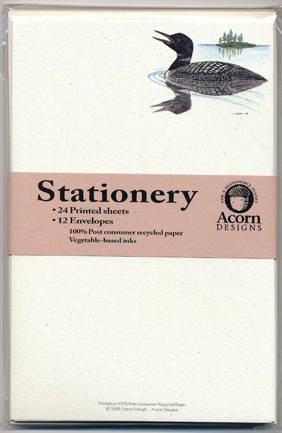
Common Loon Notecard
Common Loon (Gavia immer) The common loon is best known for its haunting calls loud yodels, mournful wails, and wild, maniacal chuckles which fill the air over its breeding lake with a sense of wilderness. Native Americans respected the loon as the spirit of Northern Waters’ Loons breed on forest lakes and slow-moving rivers across…
-
·
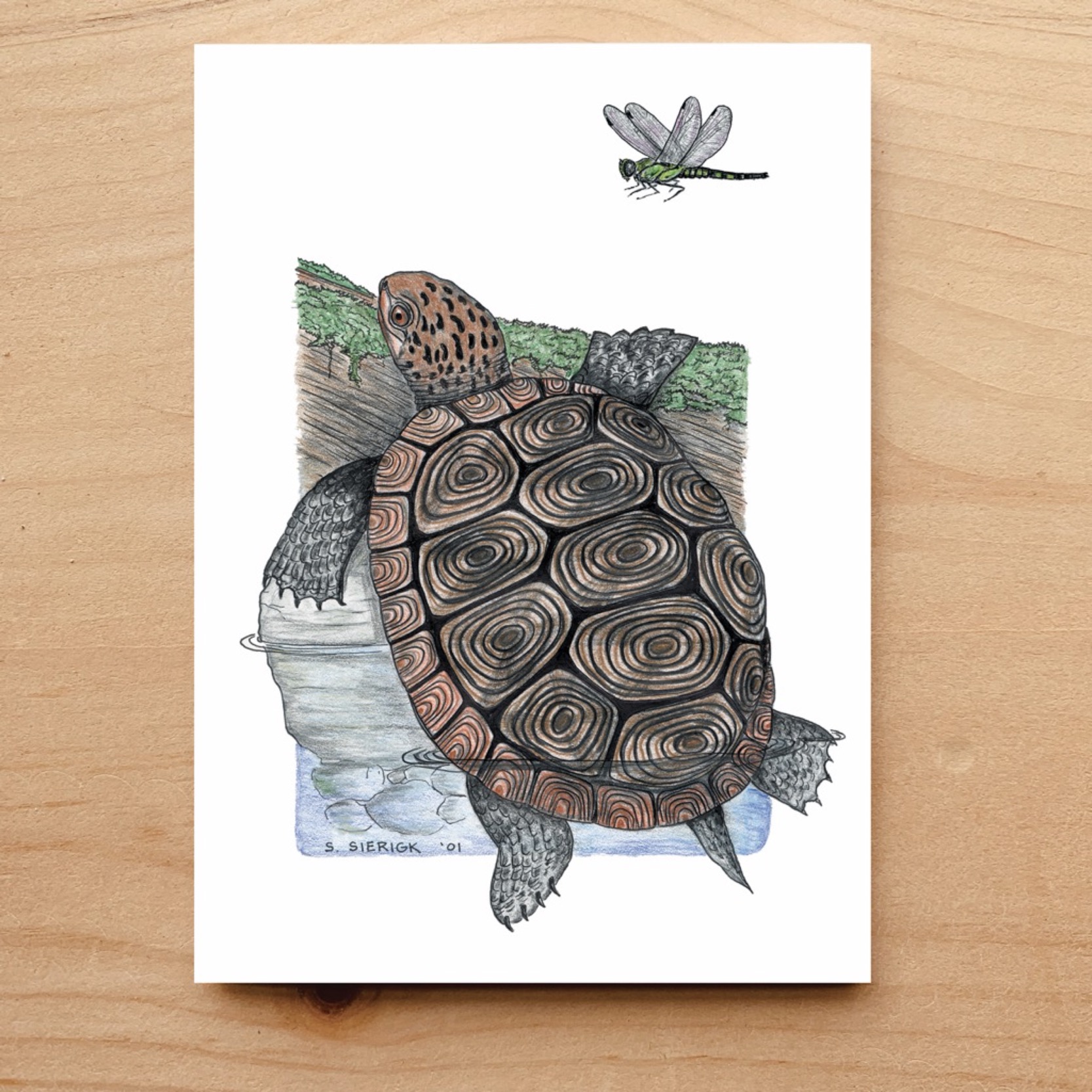
Diamondback Terrapin Notecard
Diamondback Terrapin (Malaclemys terrapin) Diamondback terrapins are one of the world’s most beautiful and colorful turtles. Diamondbacks inhabit estuaries and saltwater marshes from Cape Cod through the southern coast of the U.S.; they are our only native turtle that lives in water where the salinity comes close to or equals that of ocean water. Perhaps…
-

·
Great Blue Heron Notecard
Great Blue Heron (Ardea herodias) This majestic bird is at home in small streams, marshes, or the shores of ponds, lakes or ocean bays. Great Blue Herons are large (4 feet tall, 6-foot wingspan), common birds that nest across North America from Alaska to Mexico. Great Blues mate for life. Nests are usually made in…
-

·
Great Horned Owl Notecard
Great Horned Owl (Bubo virginianus) Nearly two feet tall, the Great Horned Owl is our largest native owl with ear tufts. Males and females are similar in appearance although the female is slightly larger. Among the fiercest of avian hunters, this impressive bird of prey carries a sense of power and dignity. It eats an…
-
·
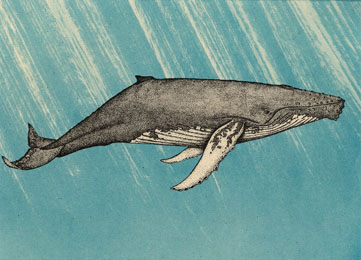
Humpback Whale
Humpback Whale (Megaptera novaengliae) The stocky, slow-moving humpbacks are perhaps the most animated and acrobatic of the great whales. They seem to be filled with a joy of living as they splash and roll, sometimes leaping clear of the water in a graceful, arching backward flip. In the open oceans, free of gravity and many…
-
·
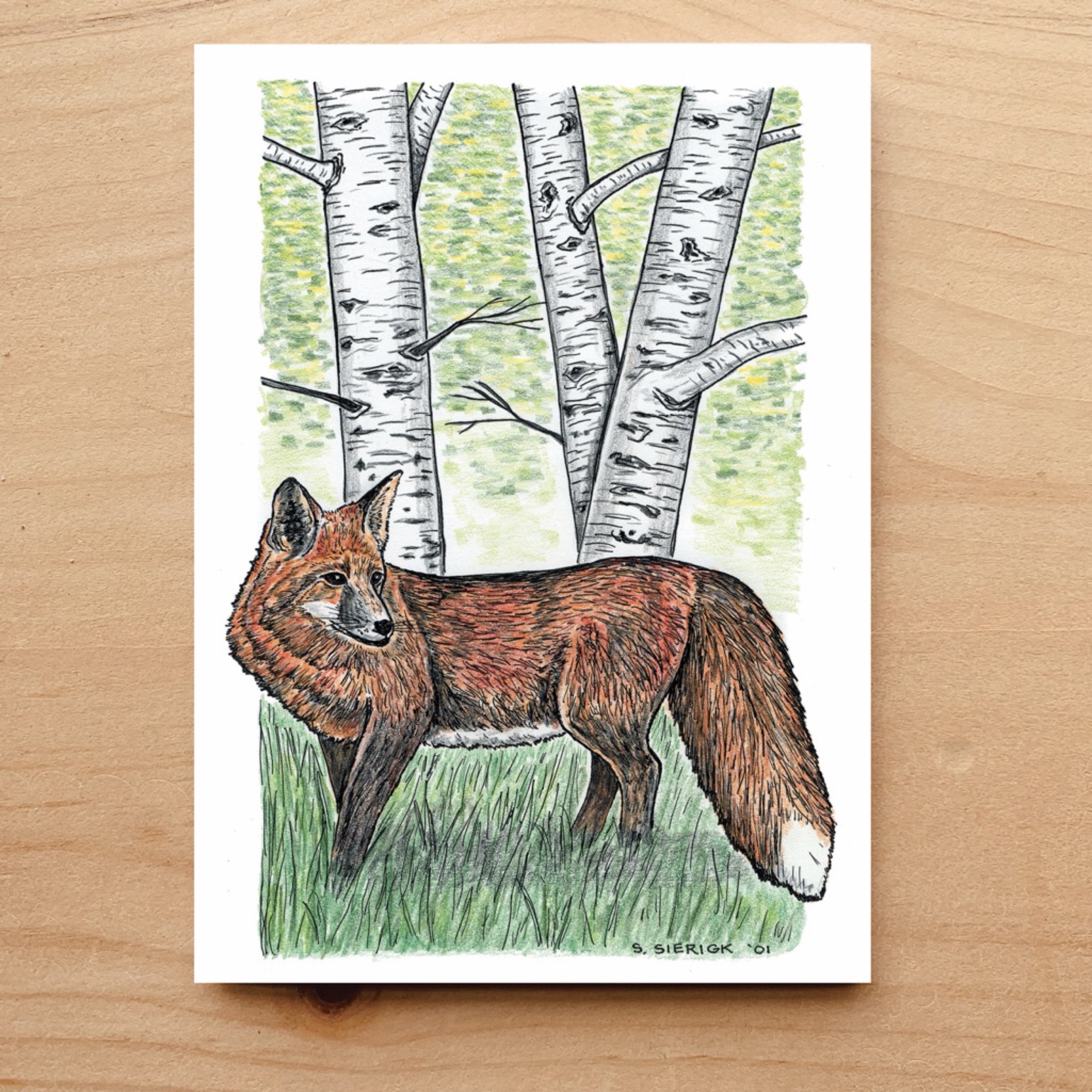
Red Fox Notecard
Red Fox (Vulpes vulpes) The red fox is renowned among the members of the canine family. With keen eyesight, sharp hearing and a powerful sense of smell, the red fox is graced with a quiet and sometimes catlike stalk. Red foxes are nocturnal, using the cover of dusk, dark or dawn as well as their…
-

·
Red-tailed Hawk in Flight Notecard
Red-tailed Hawk (Buteo jamaicensis) Red-tailed hawks are one of the most far-ranging and recognizable birds in all of the U.S. and Canada. Belonging to a group called buteos, or soaring hawks, their broad, rounded wings and fan-shaped tails take full advantage of rising warm air currents. Look for them circling overhead on clear, still days,…
-
·
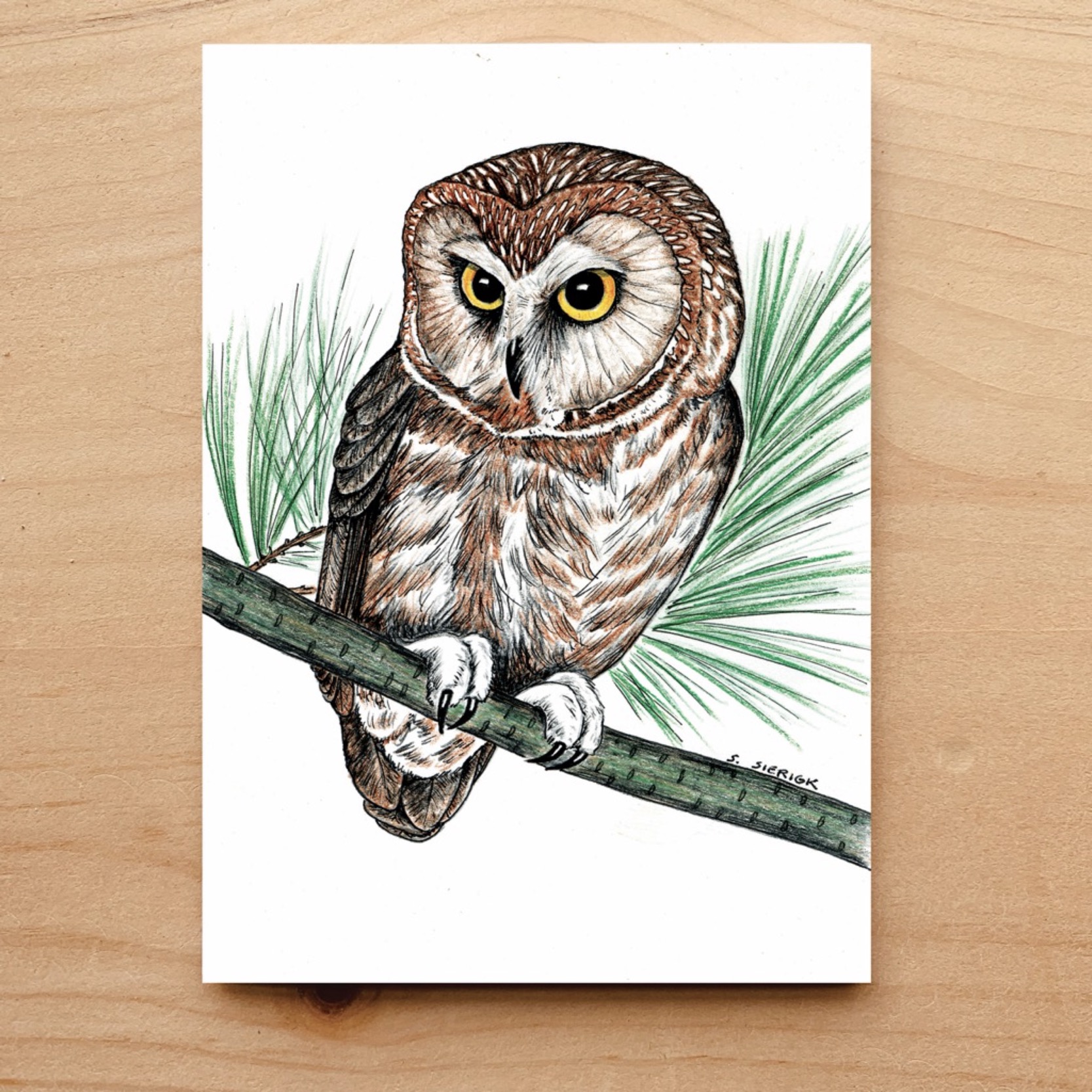
Saw-Whet Owl Notecard
Saw-Whet Owl (Aegolius acadicus) The Saw-Whet Owl is widely distributed throughout the northern parts of our continent. It resides in coniferous woodlands and is the smallest of the eastern owls, being only slightly larger than a sparrow. This well camouflaged, brown and buff bird is seldom seen as it spends the daylight hours roosting in…
-

·
Wild Turkeys Notecard
Wild Turkeys (Meleagris gallopavo) The majestic wild turkey, our largest game bird, was Benjamin Franklin’s choice for the national emblem. Others did not agree and the bald eagle was chosen instead. Inhabiting deciduous forests in many parts of the U.S., wild turkeys are becoming an increasingly familiar sight. Acorns and other nuts form the “bread…
-

·
Wood Ducks Notecard
Wood Ducks (Aix sponsa) The wood duck is a beautiful, crested bird. This illustration shows a male wood duck in the foreground and a female in the background. The male is even more colorful than the female, as he is patterned with iridescent greens, purples and blues. During summer, wood ducks range across much of…

Artist: Steve Sierigk
Originally from the metro NY area (southern Westchester County) I moved to upstate NY in the early 70’s to attend SUNY Binghamton with a focus on the biological sciences emphasizing Botany. In 1978 I moved to the Ithaca area to attend Cornell where I was enrolled as a graduate student in Entomology (fancy talk for one who studies bugs). I had taken many Scientific Illustration courses along the way. I made a portion of my living then by drawing detailed renditions of mosquito brains, moth genitalia and such.
At some point in the early 1980’s I cut my academic ties and became involved in trying my hand at farming and art. Although it was satisfying, the farming was just not paying the bills so I took my art more seriously. In this period before computer layout and design was common I made a living hand designing restaurant menus ( I am also a calligrapher), logos, wine and other food product labels. All along this time however I was developing a line of notecards and stationery products with my imagery. I called this fledgling company Acorn Designs.
As the 1980’s proceeded along my notecards were increasingly marketed across the country and became my primary business. By the late 1980’s I started inviting other artists to join in the Acorn line as I enjoyed the richness of the local art scene. Today Acorn has about 30 contributing artists from all parts of the country, but as I have the longest tenure with the company my designs are still a large part of the line. The common theme of all the artists is a respect for and a celebration of Nature.
I still enjoy being a contributing artist to our line and still even do some freelance work from time to time but my work at Acorn increasingly involves developing new products and working with other artists as well as getting the word out about us. It is always fun for me to put pen to paper as I am always amazed to see what the final product will be after spending an intensely focused period translating a 3-D image into pen or pencil work, attempting to capture some essence of a plant or creature. Enrapturing oneself into a piece of art and actively participating in it for hours, one seems to lose a sense of self and perhaps we do become a part of what we are drawing and develop a better understanding of the world.
Enjoy and appreciate the beauty around us!
www.acorndesigns.org